Why Integrated Campus Parking Technology Beats Siloed Systems Every Time
Picture a familiar scenario: a senior administrator needs a report on campus parking utilization before a meeting that starts in an hour. The parking director opens five different systems, exports several spreadsheets, and tries to reconcile numbers that don't quite match. By the time the meeting begins, they're presenting their best estimate rather than their best data.
The problem isn't that the campus lacks information. Most university parking operations have invested in permit platforms, payment systems, occupancy sensors, PARCS, parking guidance tools, and enforcement technology. Each system collects valuable data. The challenge is that much of that data exists in isolation.
When parking technologies operate as separate silos, even simple questions become difficult to answer. Staff spend time pulling reports together instead of analyzing them. Important patterns remain hidden because information from one system is never compared against information from another. Meanwhile, parkers experience the effects in the form of inconsistent payment options, confusing rules, and difficulty finding available parking.

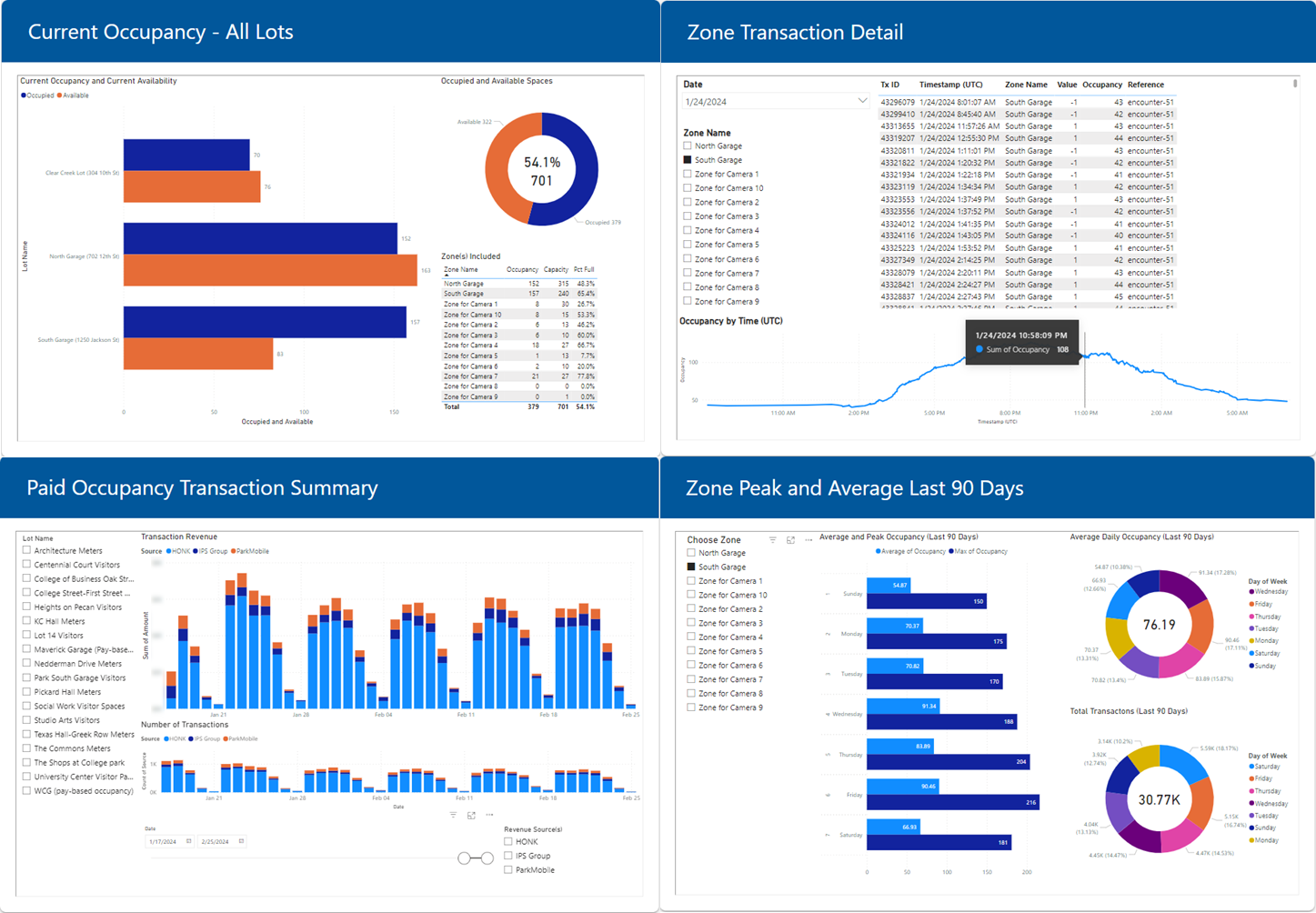
Integrated campus parking technology changes that equation. By bringing data from across the parking operation into a single, unified view, universities can move beyond fragmented reporting and gain meaningful insight into occupancy, parker behaviour, revenue performance, congestion, and sustainability. The result is a parking operation that makes better decisions, delivers a better parker experience, and gets more value from the technology it already owns.
What a Siloed Campus Parking Operation Actually Looks Like
From an operational standpoint, the picture is fractured. Payments might live in two or even three separate systems. Parking permits and citations sit in another. Transactional occupancy data is somewhere else. Event parking data is handled separately again. There is no single place where all of this comes together into a workable parking data management view.
The result is that parking directors spend time being data translators instead of decision-makers.
The problem shows up on the parker side too, in ways that are easy to overlook. When systems don't share data, parkers absorb the friction. One parking garage requires a specific payment app. Another parking facility operates on different rules depending on the day or the permit type. A visitor working through campus parking solutions isn't getting a unified experience. They're getting the visible output of years of disconnected technology choices.
It also means that occupancy data from a guidance system in one garage only helps the parkers heading to that specific location. Occupancy information in one lot only informs the parkers who happen to see that availability sign. Each piece of data does something useful in isolation. But a campus-wide, unified view is what actually helps every parker, regardless of where they're headed.
When infrastructure is siloed, the parker has to adapt to the parking system rather than the other way around.
The Blind Spots Siloed Data Creates
Inefficiency is the obvious problem. The deeper risk is what you can't see.
System A and System B might both be collecting good data. But unless you can bring the two together and look for correlation or overlap, you'll miss opportunities hidden in one system or the other. Those blind spots are exactly where bad decisions live, where a parking space appears available because the occupancy data doesn't account for permit activity, or where a congestion pattern goes unnoticed because vehicle count data and payment data have never been compared.
One important clarification: aggregating data doesn't mean replacing the systems that generate it. Payment systems still process payments. Permit systems still issue parking permits. They do those jobs well. Aggregation is the insight layer that sits on top. It's how a campus parking operation gets one collective view of everything those systems are already doing, without disrupting any of them.
What Integration Actually Enables for Parking Directors
When data from across a campus parking operation is normalized into a common format, the metrics available to a parking director go from basic headcounts to meaningful performance indicators.
Occupancy alone tells you how many cars are in a lot. When you normalize data from multiple sources through integrated parking data, you can measure dwell time (how long a vehicle stays), seek time (how long it takes a parker to find a parking space after arriving on campus), and revenue per space. These are the numbers that support real decisions about pricing, capacity, parking enforcement, and capital investment.
Multi-source data also adds depth to how you understand occupancy. Knowing how full a lot is matters. But knowing who is parking there, what their experience actually looks like, and how behavior shifts across different times of day or different days of the week is what lets you do something about it. That level of understanding makes it possible to measure parking behavior and influence it by making changes and tracking whether they're working.
An occupancy solution can tell you when a vehicle arrives or departs with high accuracy. An LPR system can identify the vehicle but is typically less precise on count. Used together, you get both occupancy volume and parker type, something neither parking solution delivers on its own. That combination matters when you're trying to understand not just how full a lot is, but who is parking there and why.
Comparing occupancy-adjacent data adds another layer. Cross-referencing parking violations with payment data, for example, can surface patterns invisible in either system alone. These are the kinds of insights that move integrated parking technology from a technical capability into a genuine strategic tool for campus parking management.
Reducing Complaints and Congestion Through Better Information
A parking director can't guide every parker to a specific parking space. What they can do is give parkers the best possible information and let them make their own decisions.
When data is aggregated across a campus, parking guidance becomes meaningful. A parker can see not just where parking availability exists right now, but what availability is likely to look like in an hour. That kind of information reduces the circling and congestion that drives complaints in the first place. Better data helps the parking operation understand itself and improves the overall parking experience for every person who parks on campus.
The Sustainability Angle Most Campuses Miss
Seek time isn't just a service quality metric. It's a sustainability metric.
Every extra minute a parker spends circling a university campus looking for a parking space is a minute of unnecessary fuel consumption. Reduce seek time and you reduce the carbon footprint of your campus parking solutions in a direct, measurable way.
Modern camera technology takes this further. Without collecting any personally identifiable information, cameras can identify vehicle make and model. That data makes it possible to estimate how many electric or hybrid vehicles are using your parking facility, and to calculate a rough carbon footprint for the operation based on vehicle type and average commute distance. The calculation isn't complicated with vehicle count, fuel type, and estimated travel distance, but the output is a concrete picture of what your parking operation contributes to campus sustainability goals. Integrated parking data management makes this possible. No single parking system working in isolation can get you there.
You're Richer in Data Than You Think
Advancing a campus parking operation doesn't require replacing what's already in place. It requires bringing together what already exists.
Every parking solution a campus has invested in over the years is generating data. The cameras, the sensors, the pay stations, the permit platform are all contributing to a picture that no one has ever looked at as a whole. Aggregate that data. Pull it into a single view. Look at it from different angles.
That's the shift we help parking operations make. A layer of integration that turns disconnected data streams into a single source of operational truth. The data is already there. It just needs somewhere to come together.