Homecoming & Game Day Lessons for Parking Lot Efficiency | Mistall
Why Event Days Break the Normal Playbook
Homecoming weekend hits, and every rule that governs a normal Tuesday on campus stops applying. Permit zones don't matter. Enforcement patterns built around regular commuters go quiet. The volume of vehicles headed for campus is nothing like what a normal parking operation handles day to day.
Event days are not a bigger version of the daily problem. They’re a different one. Most of the people showing up aren't regular parkers at all. Instead, they’re parents dropping off students, grandparents in town for commencement, and fans who set foot on campus a handful of times a year. Without someone to tell them where to go, the whole system backs up before anyone even finds a parking space.
Game day repeats more often, ten or twelve or fifteen times a semester, with more of the same faces in the crowd. But it's still the outlier to the daily routine, and treating it like a normal day is where the trouble starts for parking lot efficiency.
Where the Trouble Actually Starts
It's rarely a parking problem first. It's a traffic problem.
Multiple parking lots feed a single event, and getting vehicles to the right one happens before anyone parks at all. Cars queue at the wrong entrance and confusion about which parking lot to use starts well outside the gates. In urban campuses, the parking team is often on the phone with the city beforehand, timing traffic signals so the traffic flow holds before a single vehicle reaches campus property.
Commencement can be staged across a day, arrivals spread into waves that give traffic room to breathe. Game day doesn't offer that. Everyone shows up in roughly the same window. How they leave depends on the score. A blowout means people trickle out early. A game decided in the final minute means every seat stays full until the last play, and then the whole crowd leaves at once.
What Efficient Teams Know Before the Gates Open
It starts with a number: how many vehicles are actually coming. Most teams pull that from history, the last few years of the same event, and weigh it against the parking capacity they actually have.
Accuracy matters as much as the number itself. Permit holders cleared out. Residential parkers given a heads up to move their vehicles for the day. And real-time visibility once the gates open, because staff working blind can't redirect anyone toward open parking spaces.
Accessible Parking and Garage Capacity Need a Plan of Their Own
Accessible parking spaces are usually the first thing to disappear on a high-volume day. A visitor circling for a regular spot is annoyed, especially if they need an accessible parking space and can't find one. That's a complaint that reaches leadership fast. Treat accessible spaces as protected capacity, not first-come parking, and have enforcement check those areas specifically before the event, not just during it.
Garages fill differently than surface lots. Cars queue level by level, and once the lower floors are full, traffic backs into the street while drivers wait to find out if there's room above. Knowing parking capacity by level, not just for the structure overall, lets staff redirect cars to an open floor before that queue even forms. Safety gets harder in a garage too: tighter turns, lower visibility, pedestrians moving between parked cars and elevators all at once during peak arrival. A parking garage on game day is not the same safety environment as a parking garage on a regular day.
Watching It Unfold in Real Time
The run-up is where things get tight. Last-minute arrivals circle for whatever parking space is left, and feet on the street confirm the technology matches what's happening on the ground. Sometimes that means waving someone onto the grass. Not a legitimate parking spot, but better than turning a visitor away on the busiest day of the semester.
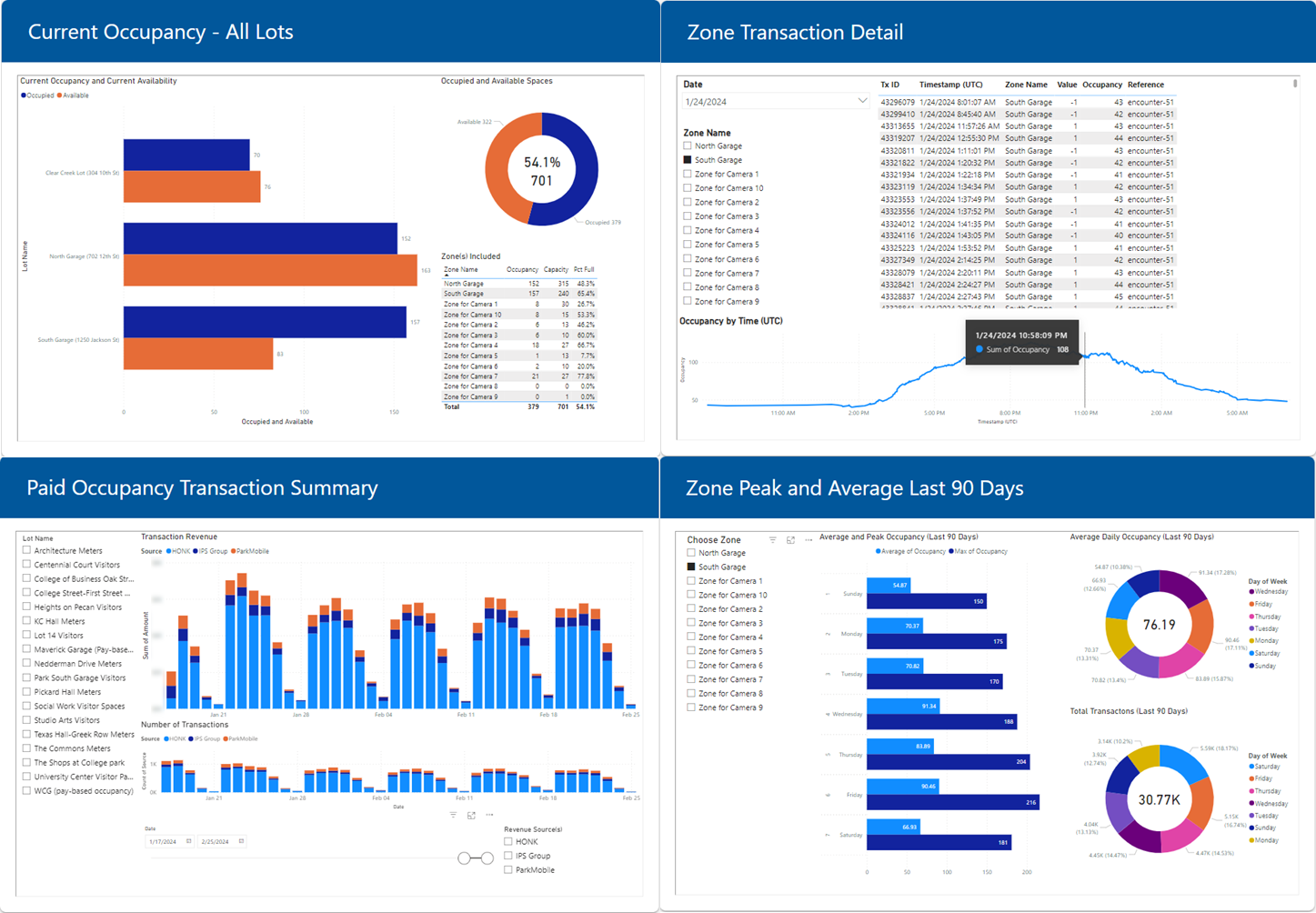
Real-time occupancy is what makes the plan work instead of just existing on paper. Fill this lot first, then that one. Route traffic from different entry points depending on where the room actually is. A team with visibility into space utilization can redirect a vehicle before a lot backs up, instead of finding out from a complaint ten minutes later.
What the Data Says After the Last Car Leaves
Start with occupancy against capacity at every parking lot. Then look at the order things filled: first, second, last. That sequence is the real shape of the event, because once a vehicle is parked, it stops being the problem. The pressure is always at the edges, getting cars in, then getting them back out.
Exit lanes deserve the closest look at traffic flow, idling time, and how long it actually takes someone to clear the lot after the final whistle or the last diploma. That's what parkers remember, not how smooth the arrival was three hours earlier. Pedestrians crossing in front of exiting traffic slow everything down, since they have the right of way every time. Favoring right turns over left turns at exits can shave real minutes off a backup that otherwise stretches for blocks. Traffic engineering, technically, but it’s parking's problem, in practice.
Turning Event Data Into the Case for Leadership
Occupancy against capacity. Arrival sequence. Exit traffic flow. Put those together, and there's a case, not just a summary.
Every event teaches something about what worked and what didn't for overall parking efficiency. That's what turns into a real staffing conversation: more hands on the ground for events this size, or outside support from municipal police for traffic control. Weather, nobody controls. Staffing and signage, someone does, and that's the part worth optimizing for efficiency.
None of it matters if it stays inside the parking office. Parkers need to know where to go before they show up, not after they're already circling, whether that's signage, dynamic displays, or something they check on their phone. Mi Mistall's real-time occupancy monitoring and dynamic guidance tools are built for exactly that gap between having the data and getting it in front of people. The same numbers that ran the event well become the case for adding staff before the next home game, or new signage before the next commencement.